Many centers participating in the Child and Adult Care Food Program (CACFP) assume that working with a sponsor shields them from getting into serious trouble. However, sponsored sites can still face the CACFP Serious Deficiency Process and even be placed on the National Disqualified List (NDL) if they do not follow CACFP rules.
If a sponsor or state agency identifies major compliance issues at your center, your sponsor must begin the CACFP Serious Deficiency Process. This gives you a chance to fix problems while still protecting the Program’s integrity.
Below is a step-by-step breakdown of the CACFP Serious Deficiency process, what each notice means, key deadlines, and practical ways to avoid SD in the first place.
Note: The exact workflow and timelines can vary slightly depending on whether you work with a sponsor or contract directly with your state agency. Always follow the instructions in your official notice.
Step 1: CACFP Serious Deficiency Determination (SD Identified)
(SD Identified)
The SD process typically begins when a sponsor (for sponsored sites) or the state agency (for independent contracts) identifies serious noncompliance.
Common reasons a center/site may be cited for Serious Deficiency:
- Spending CACFP funds on unallowable expenses.
- Not spending enough on approved foods & supplies.
- Not keeping accurate financial records, including reimbursements & expenses.
- Failure to keep an accurate and up-to-date CACFP budget.
- Repeated late claim submissions.
- Falsified or inaccurate meal claim records.
- Not following CACFP meal pattern requirements.
💡 WANT TO LEARN MORE? Check out our other blog post on serious deficiency here.
During this stage, the sponsor documents the problems and prepares a formal notice to send to your center.
Step 2: Notice of Serious Deficiency (Formal Notice Issued)
Next, your sponsor sends you a Notice of Serious Deficiency, which includes:
- The specific violations (what the issue is)
- The basis/evidence (what records or findings support the citation)
- The required corrective action (what you must do to fix it)
- The deadline to submit corrections (often within 30 days, but follow your notice)
- The potential consequences if not corrected (termination and disqualification)
Can you appeal a CACFP Serious Deficiency notice?
In many cases, the SD notice itself is not the appeal point—the appeal typically comes later if termination/disqualification is proposed. Your notice will tell you what rights you have and when.
Step 3: Opportunity for Corrective Action (Submit a Corrective Action Plan / CAP)
In response to the formal notice, your center must submit a Corrective Action Plan (CAP) with the following information:
- What you fixed immediately (specific actions already completed)
- How you will prevent it from happening again (new systems, training, checklists, oversight) Proof/documentation (receipts, updated procedures, training logs, corrected records, etc.)
- Who is responsible (named staff roles)
- Your monitoring plan (how you will check compliance going forward)
Your sponsor/state agency will review your CAP to determine whether it fully and permanently resolves the problem. If it does, the SD can be deferred (meaning you can continue participating as long as you stay compliant).
Deadline reminder: Many SD notices require corrective action within 30 days. Don’t assume—confirm the deadline on your notice.
Step 4: Notice of Proposed Termination & Disqualification (Appeal Rights Begin)
If your corrective action plan fails to permanently correct the problems, your sponsor issues you a Notice of Proposed Termination and Disqualification.
This means:
- You risk losing your ability to participate in CACFP.
- Your center – and staff – could be placed on the National Disqualified List (NDL).
Appealing at this stage
This is typically the stage where you can request an appeal/hearing. The notice should include:
- How to request the appeal
- The timeline to submit the request (often 15 days)
- What information to include
Important: Missing the appeal deadline can cause the process to move forward quickly.
Step 5: Notice of Official Termination and Disqualification (Final Action / NDL Placement)
If you lose the appeal – or if you don’t appeal at all – your sponsor issues a Notice of Termination and Disqualification.
This means:
- Your center is officially removed from CACFP.
- Your center and applicable staff are placed on the NDL.
This means you cannot participate in CACFP and other USDA programs.
How long does NDL placement last?
NDL removal is not automatic and can be long-term. Once on the NDL, you must wait at least 7 years to be removed, unless all outstanding CACFP debts are repaid sooner and specific requirements are met. Early removal is a rigorous process requiring state agency approval before you can be reinstated. Get compliance help immediately if you receive a proposed termination/disqualification notice.
To see who’s on the NDL, click here.
So…How Do You Avoid the CACFP Serious Deficiency Process?
No one wants to experience this, but there’s good news – it IS avoidable!
Here are some ways:
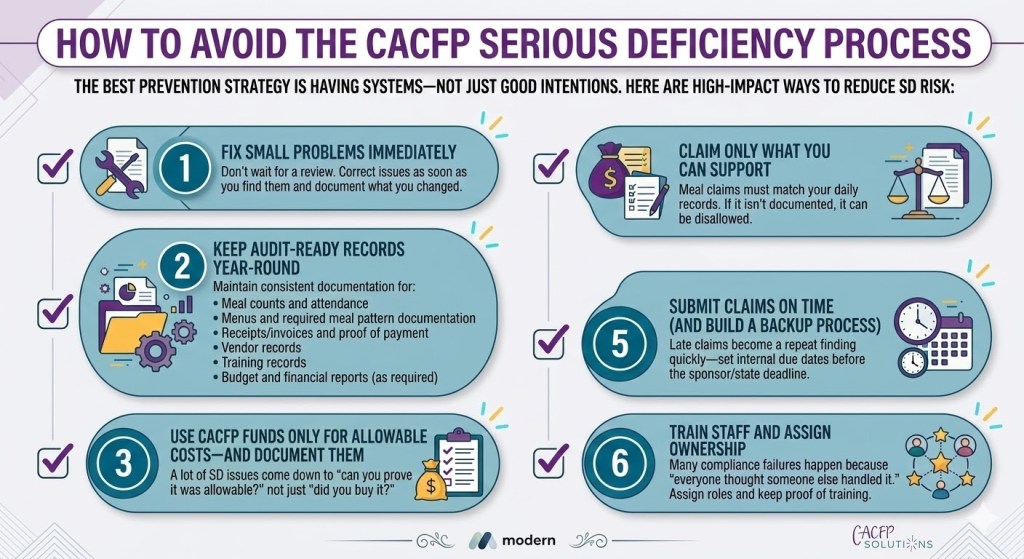
How to Avoid the CACFP Serious Deficiency Process (Practical Checklist)
The best prevention strategy is having systems—not just good intentions. Here are high-impact ways to reduce SD risk:
1) Fix small problems immediately
Don’t wait for a review. Correct issues as soon as you find them and document what you changed.
2) Keep audit-ready records year-round
Maintain consistent documentation for:
- Meal counts and attendance
- Menus and required meal pattern documentation
- Receipts/invoices and proof of payment
- Vendor records
- Training records
- Budget and financial reports (as required)
3) Use CACFP funds only for allowable costs—and document them
A lot of SD issues come down to “can you prove it was allowable?” not just “did you buy it?”
4) Claim only what you can support
Meal claims must match your daily records. If it isn’t documented, it can be disallowed.
5) Submit claims on time (and build a backup process)
Late claims become a repeat finding quickly—set internal due dates before the sponsor/state deadline.
6) Train staff and assign ownership
Many compliance failures happen because “everyone thought someone else handled it.” Assign roles and keep proof of training.
The Bottom Line
The CACFP Serious Deficiency Process isn’t meant to punish centers. Instead, it protects Program integrity. By staying informed and diligently following guidelines, it is possible to avoid serious deficiency.
What’s Next?
Now that you know how the CACFP Serious Deficiency Process works, you might be wondering what happens after a center is placed on the National Disqualified List (NDL)? How do you get off it?
Don’t miss our next post: “What Is the CACFP Disqualified List and How to Get Off It?”—where we’ll break down the consequences of NDL placement and how you can be removed. Stay tuned! 🚀