
Serious deficiency can involve the way a program keeps records, claims meals, manages funds or carries out its responsibilities.
The exact finding matters. A missing receipt, an incorrect claim and deliberate falsification should not all be described as the same thing.
This article explains areas to check. It is not a finding that your program is seriously deficient.
Concerned about a finding or a gap in your records? Book a call with CACFP Solutions to discuss your situation and the help you need.
Can a sponsored center face serious deficiency or NDL consequences?
Yes. Do not assume sponsorship protects your center or everyone working there from serious-deficiency or disqualification action.
Two points matter:
- State procedures can provide a serious-deficiency pathway for sponsored centers. Texas expressly does so for unaffiliated child care centers, at-risk centers and adult day care centers. [1]
- Federal definitions allow people employed by or under contract with a sponsored center to be identified as responsible for an institution’s serious deficiency. [2]
A sponsor’s responsibilities and a center’s responsibilities are related, but they are not interchangeable. Check who is named, what conduct is cited and which procedure applies.
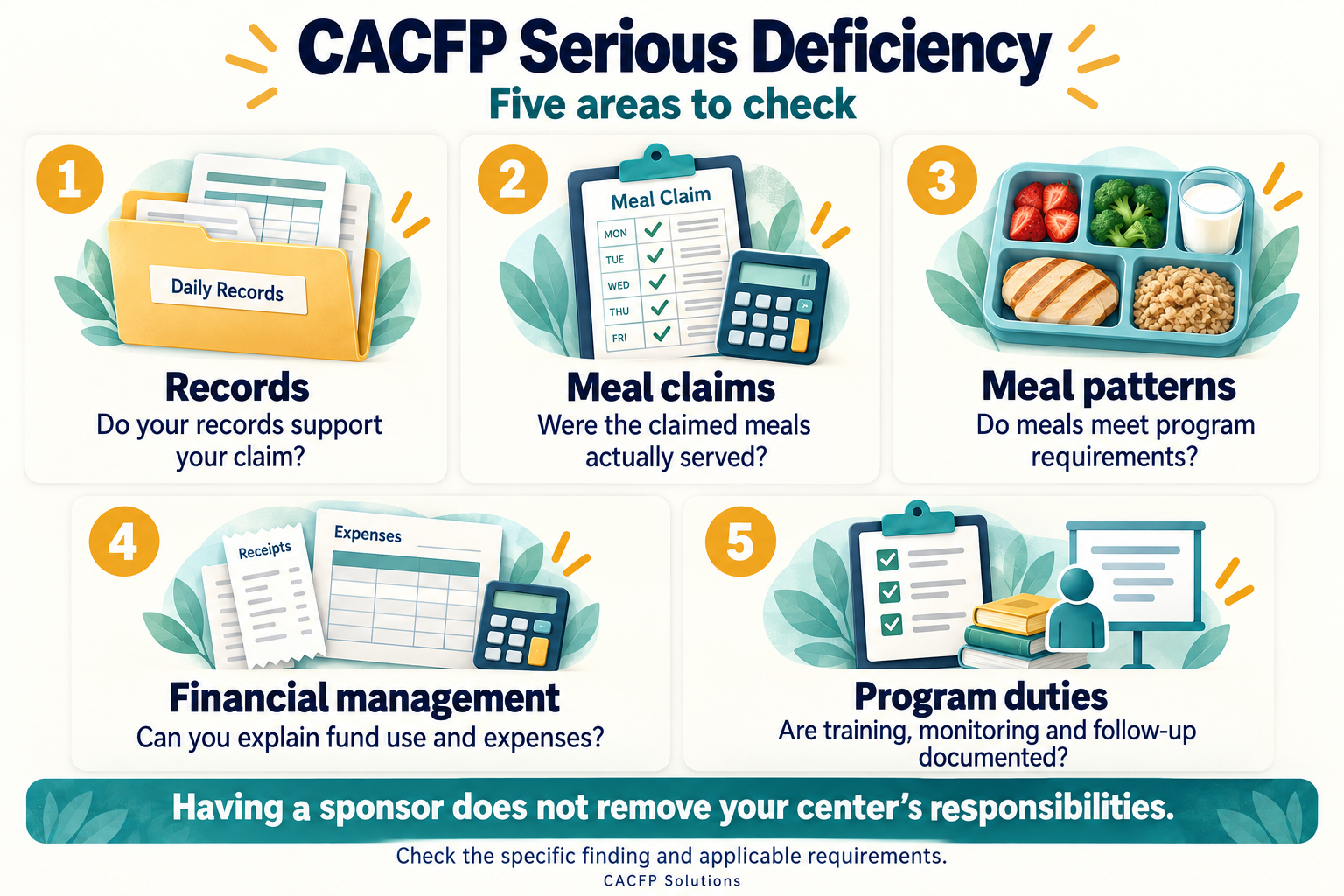
1. Records that do not support the claim
Federal rules list inadequate records as a serious deficiency for participating institutions. [3]
Our practical recommendation:
- Keep the records required for your program type.
- Check that meal counts, attendance and claim totals make sense together.
- Keep menus and supporting meal documentation.
- Keep receipts and payment records.
- Keep required training documentation.
- Investigate gaps before submitting the claim.
A total on a claim needs records behind it.
2. Claims for meals that were not served
Claiming reimbursement for meals not served is on the federal serious-deficiency list. [3]
Check for:
- Duplicate counts.
- Totals that do not match daily records.
- Meals entered for days the center was closed.
- Corrections that were never carried through to the claim.
Our practical recommendation: Investigate and correct discrepancies promptly. Do not label every clerical error “fraud,” but do not ignore a pattern or knowingly submit unsupported information.
3. Significant meal-pattern failures
Federal rules identify claiming a significant number of meals that do not meet program requirements as a serious deficiency. [3]
Our practical recommendation: Check:
- Required components.
- Portions for the applicable age group.
- Creditable foods.
- Menus and supporting records.
- Whether staff know how to handle substitutions.
Review the requirements for the meal and population you serve. Do not assume one checklist fits every program.
4. Financial records and fund use that cannot be explained
CACFP reimbursement supports the operation or improvement of the nonprofit food service. [2]
Our practical recommendation: Make sure you can explain:
- What reimbursement was received.
- What expenses were charged.
- Why those expenses belong to the food service.
- How payment is documented.
- Which costs require prior approval.
- How balances and budget changes are handled.
Is a separate bank account required?
USDA recommends a separate account for CACFP funds but does not impose a universal federal CACFP requirement. Additional applicable state or agreement requirements still need to be checked. [4]
A separate account can help. It does not replace accurate accounting.
Does an unspent balance automatically mean serious deficiency?
Do not make that conclusion from a balance alone.
Check the applicable rules, approved budget and financial records. Do not make unnecessary purchases simply to spend every dollar.
For institutions, federal budget requirements distinguish sponsors’ annual administrative budgets from independent centers’ budget submissions as required by the state agency. [5]
For help with records and reconciliation, see our CACFP accounting services.
5. Required duties that are not being carried out
A sponsor has responsibilities that go beyond collecting meal counts.
The federal serious-deficiency list includes failures to:
- Properly train or monitor sponsored facilities.
- Disburse payments as required.
- Carry out required financial and administrative responsibilities. [3]
Our practical recommendation for centers:
- Complete required training.
- Keep evidence of completion.
- Respond to findings.
- Ask for unclear instructions in writing.
- Assign someone to follow through.
Our practical recommendation for sponsors:
- Document training, monitoring and follow-up.
- Investigate claim discrepancies.
- Track required payments.
- Make sure findings receive a documented response.
Does correcting the problem erase serious deficiency?
Successful correction in the federal institution process results in temporary deferral. That is different from erasing the determination. [6]
If you have a notice, work from its findings and deadline—not a general checklist.
Read CACFP Serious Deficiency Process: What Happens After a Notice? for the response steps.
Start with the problem you can document
Our practical recommendation:
- Identify the requirement.
- Compare it with your records.
- Correct the problem.
- Document what changed.
- Assign ongoing responsibility.
- Check that the correction continues.
Need help reviewing findings or organizing a response? Explore CACFP Solutions’ services for program reviews, corrective action and accounting support.
Sources
- Texas CACFP Handbook, Section 10000, especially 10600–10610. State example; March 2026 edition, PDF pages 381–383.
- 7 CFR 226.2 — responsible persons and nonprofit food service.
- 7 CFR 226.6(c)(3)(ii) — serious deficiencies for participating institutions.
- USDA Child Nutrition Program Integrity final rule, document page 31, financial-review discussion.
- 7 CFR 226.7(g) — budget approval.
- USDA Serious Deficiency, Suspension and Appeals Handbook, Part 1.