
Sponsorship does not remove your center’s responsibility
“I have a sponsor, so this only applies to them.”
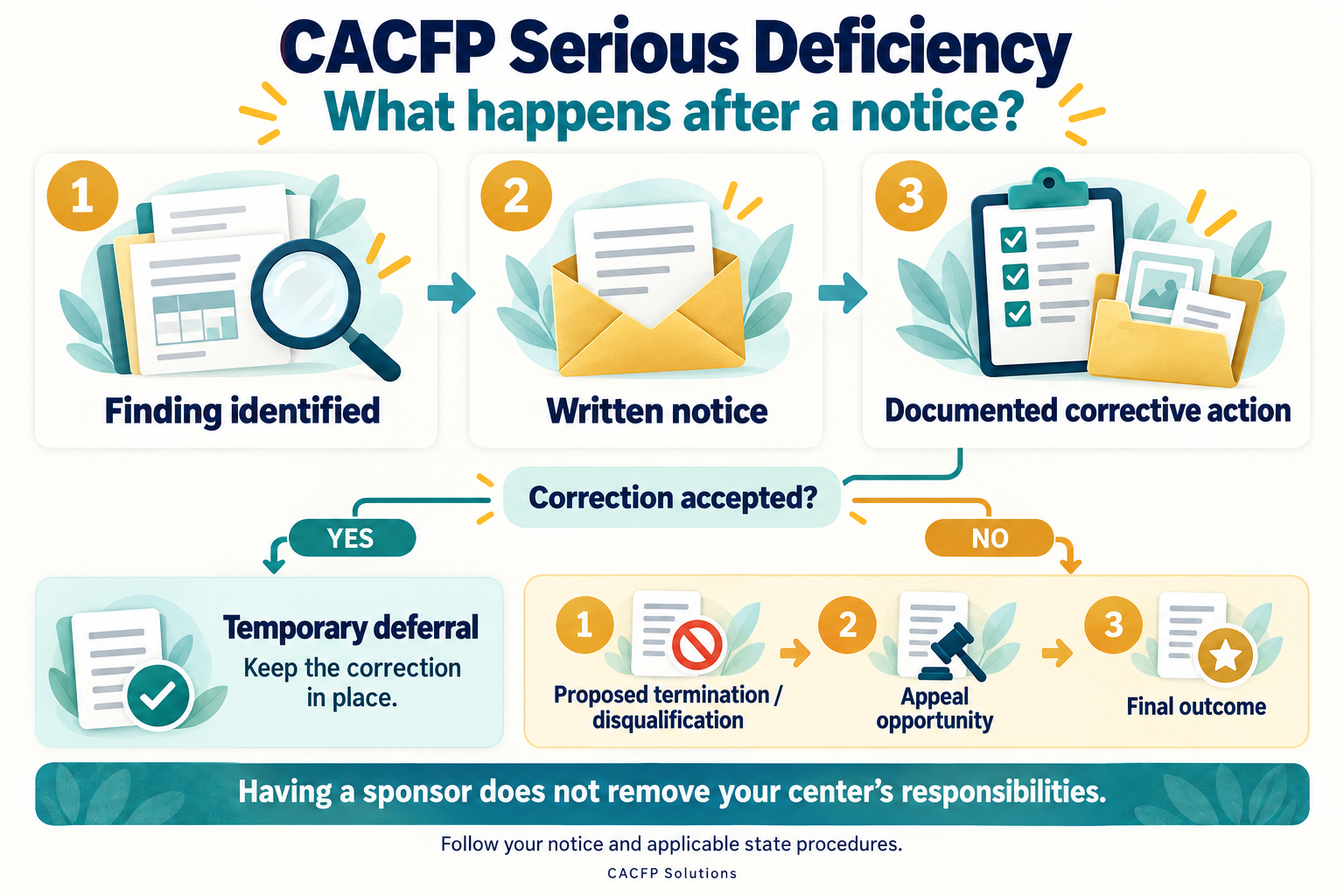
Do not rely on that assumption. Sponsorship provides support and oversight. It does not remove your center’s responsibility for its records, meal service and claims.
Sponsored centers can face serious-deficiency action under applicable state procedures. For example, Texas has a sponsor-led process for unaffiliated child care centers, at-risk centers and adult day care centers. That example should not be treated as an identical procedure in every state. [1]
People working at a sponsored center can also be identified as responsible for an institution’s serious deficiency under the federal definitions. The organization and the people named in a notice need to understand their own position. [2]
Received a notice and need help with your next step? Book a call with CACFP Solutions to discuss the findings and the help you need.
First, know who the notice concerns
The notice may concern:
- An independent center with its own state-agency agreement.
- A sponsoring organization.
- A sponsored center.
- Owners, managers or other people identified as responsible.
For independent centers and sponsors, the state agency generally administers the federal institution process. Sponsored centers must check the state procedures and their sponsor agreement.
Our practical recommendation: Read the notice before deciding which process applies. Identify:
- Who issued it.
- Which organization and people are named.
- Each finding.
- The response deadline.
- The required documents.
- Any appeal instructions.
1. A serious deficiency is identified
A review or investigation identifies a problem that rises to serious deficiency.
For participating institutions, federal examples include:
- Inadequate records.
- Claims for meals not served.
- Claims for a significant number of meals that do not meet requirements.
- Failures of required financial or administrative responsibilities. [3]
A questioned claim and a serious-deficiency notice are different actions. Read what the agency or sponsor has actually issued.
2. A written notice explains the findings
The notice identifies the problems and the required response.
Check it for:
- The rule or requirement behind each finding.
- The action required.
- The deadline.
- The people named as responsible.
- The consequences of failing to correct the problems.
Under the federal institution procedure, the serious-deficiency determination itself is not appealable. Other actions may have separate appeal rights. [3]
Do not assume you have 30 days. Use the deadline in your notice.
3. You document corrective action
A corrective action plan should explain what changed and show that the changes happened.
USDA guidance calls for details about:
- What: the problem and the new procedure.
- Who: the person responsible.
- When: the implementation date and ongoing schedule.
- Where: the supporting records are kept.
- How: staff were informed and the procedure is carried out. [4]
Our practical recommendation: Organize the response by finding. Include the corrected records, procedure, training documentation or other evidence relevant to that finding.
“We will do better” is not a documented correction.
Successful correction in the federal institution process results in temporary deferral. It does not erase the history. [4]
4. Termination and disqualification may be proposed
If timely corrective action does not fully and permanently resolve the findings, the next notice may propose termination and disqualification.
Check:
- Which parties face the proposed action.
- The basis for the proposal.
- The appeal deadline.
- Where the request must be sent.
- What supporting documents are required.
The proposed action is an important appeal stage in the federal institution process. Follow the notice and applicable procedures. [3]
5. The process reaches a final outcome
If the proposed action stands, termination and disqualification can follow.
The National Disqualified List, or NDL, concerns disqualified organizations and responsible people. It is not simply a list of “bad centers.” Being an employee does not automatically mean every staff member is listed. [2]
Health-and-safety threats and false or fraudulent claims can involve suspension procedures. Do not assume every case follows the ordinary sequence above. [3]
Can you get off the NDL?
For institutions and responsible people, the federal rule provides two routes:
- USDA FNS, in consultation with the state agency, determines that the deficiencies have been corrected.
- Seven years have elapsed since disqualification.
Unpaid CACFP debt keeps the party listed until repayment. Paying debt alone does not establish eligibility for early removal. [3]
What should you do next?
Our practical recommendation:
- Keep the notice and attachments together.
- Assign responsibility for each finding.
- Start collecting evidence immediately.
- Keep proof of submission.
- Track every deadline separately.
- Do not assume changing sponsors makes a notice disappear.
For common causes, read What Can Make a CACFP Program Seriously Deficient?.
Need help putting the response together? CACFP Solutions can help you review findings, organize records and prepare corrective-action documentation. Explore our CACFP services.
Sources
- Texas CACFP Handbook, Section 10000, especially 10600–10610. State example; March 2026 edition, PDF pages 381–383.
- 7 CFR 226.2 — definitions of institution, principal and responsible principal or individual.
- 7 CFR 226.6, especially (c)(3), (c)(5), (c)(7)(v) and (k).
- USDA Serious Deficiency, Suspension and Appeals Handbook, Part 1. Implementation guidance; regulations and applicable state procedures control.