

The financial viability review asks whether your organization can afford to operate CACFP, keep paying bills if reimbursement is interrupted, and repay program funds if required. [1]
Showing a profit is not always necessary. A loss needs attention, but your P&L alone does not tell the whole story. Available cash, other resources, and debts also matter.
What Happens When Your Numbers Are Reviewed?
The financial reports supply the numbers. The assessment examines how they fit together.
Financial ratios—calculations that compare parts of your financial picture—help examine:
- Resources available to cover upcoming bills.
- What the organization owes compared with what it has.
- Whether income covers expenses or other resources must cover a shortfall.
Our practical view: These measures need to be considered together. A profit does not automatically establish financial readiness, and a loss does not automatically rule it out.
What Financial Records Should You Have Ready?
Start with these records, then check your state agency’s packet for the exact requirements:
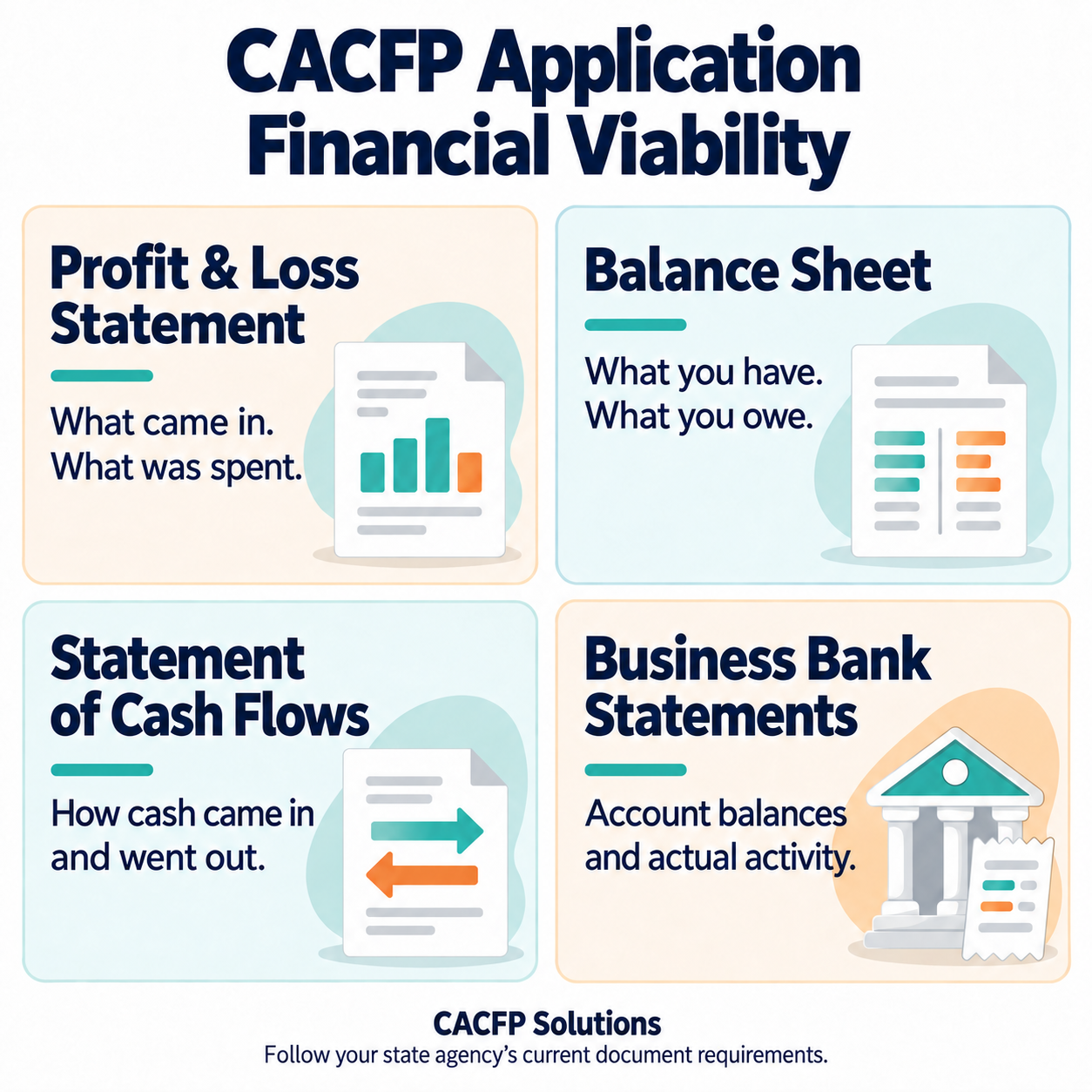
- Profit and loss statement: Shows income and expenses.
- Balance sheet: Shows what the organization has and what it owes.
- Statement of cash flows: Shows how cash came into and left the organization.
- Business bank statements: Show account balances and actual business activity.
For example, the Texas financial-review form supplied for this article lists all three financial statements. It also requests bank statements, a detailed general ledger, supporting financial records, and loan documents when applicable. [4]
Texas requires new applicants to provide at least 12 months of bank statements showing business activity. Sponsors may need several years of financial statements or qualifying audits. [2]
Document requirements and reporting periods can differ. Use the current instructions sent to your organization.
Why Isn’t the P&L Enough?
A P&L tells you whether income exceeded expenses during the period reviewed. It does not tell you how much money is available to pay tomorrow’s bills.
The other records help answer:
- Is cash available when payments are due?
- Are there debts or unpaid bills that need to be considered?
- Are the reported figures supported by actual account activity?
For example, Texas considers resources outside its nutrition programs when assessing financial viability. Applicants already receiving TDA food-program funds must submit financial documentation reflecting non-TDA income and expenses. [2, 3]
Does Your Proposed Program Matter?
Be ready to describe:
- Number of sites.
- Expected daily participation.
- Meals served.
- Operating days.
Texas, for example, states that its financial viability determination is based on the applicant’s projected CACFP reimbursement. [3]
Our recommendation: Describe the operation you realistically expect to begin. Your financial records need to be assessed alongside that proposed operation.
What Should You Do Next?
Gather the requested records and check:
- Do they identify the organization applying?
- Do they cover the requested dates and periods?
- Are any figures missing or unexplained?
If your P&L shows a loss, do not assume that alone rules you out. Look at the full financial picture before deciding whether to proceed.
For Texas applicants, our CACFP application roadmap explains where financial viability fits into the process.
Want Help Understanding Your Numbers?
Our CACFP specialists can assess your financial records, explain the results, and identify areas needing attention before you move further into the application.
Explore our CACFP application services for financial review and application support.
Your state agency makes the approval decision.
Sources
Federal requirements provide the foundation. Texas materials illustrate one state’s process; follow your own state agency’s current instructions.
- 7 CFR § 226.6(b)(1)(xviii)(A)(2) — Fiscal resources and financial history.
- Texas CACFP Handbook, Section 2000, March 2026, § 2221.1 — Financial Viability and Financial Management.
- TDA New CACFP Applicants — Step 2: Viability.
- CACFP Financial Viability Review form, captured July 18, 2024, pages 5–6; supplied source copy. Confirm current submission requirements against your applicant packet.
Public guidance checked October 5–6, 2026.