
If you have started a Texas CACFP application and are unsure what comes next, start with the last step you actually completed. Did you submit the intake? Send your financial documents? Receive access to the application system? Respond to a correction request?
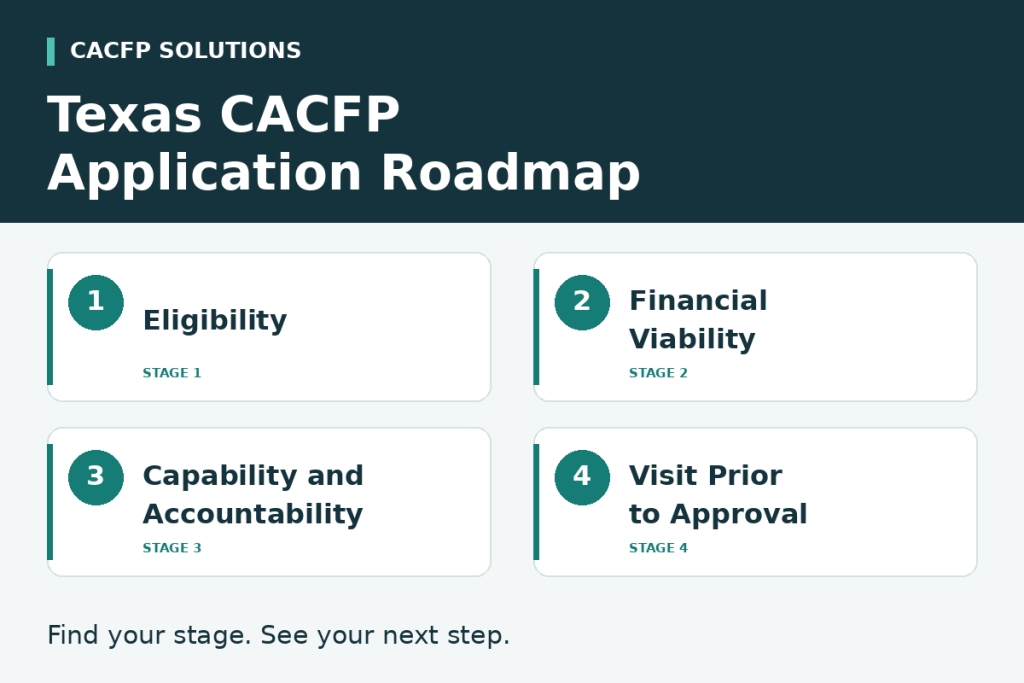
This roadmap follows TDA’s four stages: Eligibility, Financial Viability, Capability and Accountability, and Visit Prior to Approval. It focuses on new center applicants seeking their own CACFP agreement. School food authorities and some existing summer food program operators have different pathways. [1, 2]

How to Read the Suggested Timelines
The graphic uses these proposed CACFP Solutions planning estimates:
| Stage | Suggested planning estimate |
|---|---|
| Eligibility | 7 business days |
| Financial Viability | 7 business days |
| Capability and Accountability | 21 business days |
| Visit Prior to Approval | 14 business days |
These are professional planning estimates, not measured averages, TDA deadlines, or a guarantee of approval. They should help you organize the work; they do not establish when TDA will finish its review.
TDA describes separate 90-day periods for financial viability and the online application, seven TDA business days per application submission review, and 30 days for a final determination upon reaching Stage 4. [1]
CACFP Solutions recommends tracking the handoff as well as the date. Record what you submitted, what TDA requested, and what remains outstanding. That is more useful than judging progress against an estimated date alone.
Taking longer than you expected?
Sometimes a second set of eyes is all you need. Talk it through with a CACFP specialist and get a clearer sense of what needs attention next.
Stage 1 Eligibility
Your starting point: Complete the TDA intake form.
TDA checks the organization and contact individual, then emails the applicable next steps. Its published eligibility-check period is five business days, excluding TDA and federal holidays. [1]
CACFP Solutions recommends:
- Save your intake confirmation and a copy of your responses.
- Keep the submission date with your application records.
- Check the email address used on the intake, including its spam folder.
- Read TDA’s next-step email before deciding what to submit next.
If you need help with the fields, see our TDA intake walkthrough.
If you are stuck here: Find the confirmation and any subsequent TDA correspondence. If the stated review period has passed and you have no instructions, follow up with TDA using your submission date and organization name.
Stage 2 Financial Viability
Your next step: Follow the financial-viability instructions TDA emails after eligibility review. The review applies when TDA requires it. [1]
Financial viability concerns whether your organization can fund program operations, including interruptions in reimbursement, using resources outside TDA’s nutrition programs. [2]
Financial documents to gather
CACFP Solutions recommends assembling these records for packet preparation:
- Profit and loss statement.
- Balance sheet.
- Statement of cash flows.
- At least 12 months of business bank statements.
TDA’s handbook specifies at least 12 months of operational bank statements for new applicants. Other financial evidence varies by applicant type; use your requested packet to determine the required statements, periods, and additional documents. [2]
Required applicant training
Complete the required applicant training and retain the certificate. TDA requests training evidence during financial-viability review and will not review an application without required training completion. [1, 2]
CACFP Solutions recommends:
- Gather records while waiting for TDA’s instructions.
- Identify the legal organization whose finances are being reviewed.
- Check that the statements cover the requested periods.
- Keep training proof with the packet.
- Follow the submission instructions in TDA’s email.
If you are stuck here: Identify the specific unfinished item: missing records, incomplete training, an unanswered financial question, or a request from TDA. That gives you a concrete next action.
The handoff: Once viability is accepted, TDA provides the application-system access-request process. Complete that handoff before entering the online application. [1]
Stage 3 Capability and Accountability
Your next step: Build the online application and provide its supporting documents.
Your application needs to describe how your organization will administer CACFP. Use the application’s actual checklist to identify what must be entered or submitted. [2]
Work through the components separately:
- Center information: Location, contacts, operating days and hours, and planned meal services.
- CACFP budget: Proposed program costs and the information supporting them.
- Management plan: Staff assignments and written operating procedures.
- Supporting documents: Applicable legal records, licensing, organizational chart, agreements, and other checklist items. [3]
The management plan must explain responsibilities, tasks, frequency, methods, and where procedures are available. [2]
CACFP Solutions recommends:
- Check that the application and supporting documents describe the same organization and operation.
- Compare staff assignments with the management plan and budget.
- Review every checklist item before submission.
- Keep each correction request with the response and resubmission date.
TDA requires the applicant’s authorized user to retain responsibility for completing the application; its handbook specifically addresses responsibility for application materials, budgets, and management plans. [2]
TDA reviews completeness and accuracy and returns missing items for correction. [1]
If you are stuck here: Use the latest correction request as your working list. For each item, identify what TDA asked for, what you changed, and whether you submitted the response. Ask for clarification when the requested change is unclear.
Not sure what that message in UNPS is asking you to do?
It can help to talk through the request before changing your application. We can help you understand what TDA is asking for and discuss the work needed to respond.
The handoff: For the new-center pathway covered here, prepare for the Visit Prior to Approval once TDA directs you to that stage. A submitted application alone does not establish approval.
Stage 4 Visit Prior to Approval
Your next step: Be ready to demonstrate the operation described in your application.
TDA’s visit evaluates management ability and resources, verifies application information, and provides technical assistance. Inconsistencies can result in denial. [4]
CACFP Solutions recommends preparing to show:
- Which staff members own the program responsibilities.
- Where procedures and records are kept.
- How your planned meal service will operate.
- How staff will carry out the tasks in the management plan.
If you are stuck here: Review TDA’s visit correspondence and any requested documents or follow-up items. Make sure each has an owner and a response date.
The endpoint: Follow TDA’s written approval and agreement instructions. Confirm the approved participation and claiming dates rather than assuming the visit itself authorizes reimbursement.
Want to Talk to a Real Person?
You don’t need to have everything figured out before reaching out. Tell us where you are and what you’re unsure about. No obligation—just a conversation about your application and whether we can help.
Or call 512-657-8036.
Official program questions: Contact TDA at 877-839-6325 or your Education Service Center. [2]
Sources
Texas sources checked October 5, 2026. Confirm applicant-specific instructions directly with TDA.
- TDA New Applicants overview.
- TDA CACFP Handbook Section 2000, March 2026, especially subsections 2210–2221, 2280, and 2300–2310.
- TDA Independent Centers application information. The webpage carries a June 2020 revision date; use the applicant’s current checklist to confirm documents.
- TDA CACFP Handbook Section 5000, March 2026, subsection 5100.