
When an institution, facility, owner, officer, or other responsible individual is placed on the USDA CACFP National Disqualified List (NDL), the most immediate consequence is losing eligibility to participate in the Child and Adult Care Food Program (CACFP).
But that may not be the end of the problem.
A CACFP National Disqualified List — commonly called the NDL — listing can potentially affect participation in other federal and state programs as well. The extent of those consequences depends on the program involved, the legal authority governing that program, and whether the disqualification applies to the organization, an individual responsible principal, or both.
A CACFP NDL listing should not be viewed only as a CACFP reimbursement problem. In some circumstances, it can become a broader program-eligibility problem.
Texas provides a particularly clear example. A child-care provider placed on the CACFP NDL can also lose eligibility to receive Texas subsidized child-care payments.
Understanding why requires separating several related concepts: CACFP disqualification, the National Disqualified List, reciprocal Child Nutrition Program disqualification, federal debarment, and eligibility rules imposed by other publicly funded programs.
What Is the CACFP National Disqualified List?
The National Disqualified List is maintained by USDA’s Food and Nutrition Service as part of CACFP’s serious deficiency and disqualification system. For a full walkthrough of how the list works, see our companion article, What Is the CACFP National Disqualified List (NDL) and How to Get Off It?
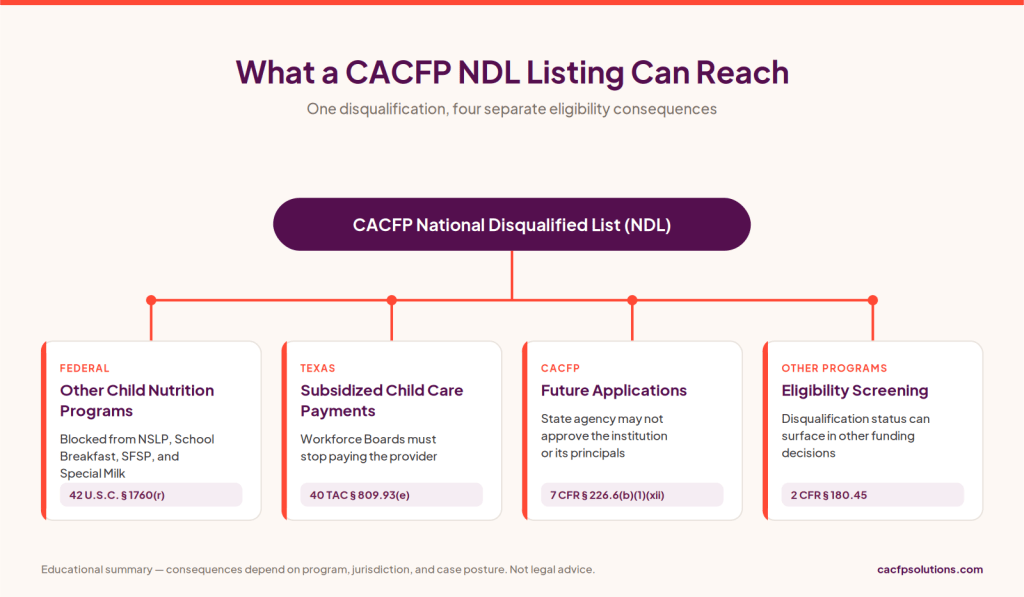
Under the CACFP regulations, if an institution or one of its principals is on the NDL, a State agency may not approve the institution’s application to participate in CACFP. The same restriction applies when a sponsoring organization submits an application involving a facility or principal appearing on the list. See 7 CFR § 226.6(b)(1)(xii).
USDA guidance explains that when an institution and responsible principals or individuals fail to adequately correct serious deficiencies, termination and placement on the NDL can follow. That process is described step by step in CACFP Serious Deficiency Process: Steps, Deadlines, and How to Avoid Being Declared Seriously Deficient. USDA also explains that the NDL prevents responsible individuals from simply moving to another organization or another state and resuming CACFP participation there.
An NDL listing generally can remain in place for seven years. Certain circumstances, including unpaid CACFP debt, can extend that period. Earlier removal may be possible when the underlying deficiencies have been corrected and the applicable requirements for removal have been satisfied.
How a CACFP NDL Listing Reaches Other Federal Programs
Federal law contains an explicit cross-program restriction for USDA Child Nutrition Programs.
Section 12(r) of the Richard B. Russell National School Lunch Act, codified at 42 U.S.C. § 1760(r), provides that a school, institution, service institution, facility, or individual that has been terminated from a Child Nutrition Program and appears on a CACFP or SFSP disqualification list may not be approved to participate in or administer another program authorized under the National School Lunch Act or Child Nutrition Act.
This provision was added by the Healthy, Hunger-Free Kids Act of 2010. USDA has described the purpose of the provision as preventing entities terminated or disqualified from one Child Nutrition Program from moving into another Child Nutrition Program.
Which USDA Child Nutrition Programs Are Affected?
In practical terms, the federal statutory restriction reaches across the USDA Child Nutrition Program family rather than stopping at CACFP. These programs include, among others:
- the Child and Adult Care Food Program (CACFP);
- the National School Lunch Program (NSLP);
- the School Breakfast Program (SBP);
- the Summer Food Service Program (SFSP); and
- the Special Milk Program.
USDA has referred to this concept as reciprocal disqualification. Its more detailed regulatory treatment has been addressed in subsequent rulemaking concerning CACFP and SFSP serious deficiency procedures.
CACFP Disqualification Is Not Automatically the Same as Federal Debarment
This distinction is important. The terms disqualification, exclusion, and debarment are sometimes used interchangeably in ordinary conversation, but federal regulations distinguish between them.
Under 2 CFR § 180.110, an “exclusion” generally refers to a discretionary action taken under the federal suspension and debarment system. A “disqualification,” by contrast, refers to a prohibition arising under another statute, regulation, executive order, or legal authority. “Ineligibility” is the broader concept and can encompass either exclusion or disqualification.
Therefore: being placed on the CACFP National Disqualified List does not, by itself, mean that a person has automatically been debarred from every federal program. That would be too broad a statement.
However, federal regulations specifically contemplate circumstances in which a person may be disqualified under one legal authority and that disqualification becomes relevant when eligibility for another federal transaction is considered.
Under 2 CFR § 180.45, federal agencies may provide for disqualified persons to be identified through the federal exclusion system and require agencies and participants to check for disqualified persons before certain covered transactions. At the same time, § 180.45 makes clear that the actual transactions affected by a disqualification depend upon the statute, regulation, executive order, or other legal authority that created the disqualification.
That distinction explains why an NDL listing can produce significant collateral consequences without creating a universal ban from every federally funded activity.
CACFP Itself Looks at Ineligibility From Other Publicly Funded Programs
There is another important piece of the regulatory structure. CACFP does not look only at whether an applicant is already on the NDL.
Under 7 CFR § 226.6(b)(1)(xiii), a State agency is prohibited from approving a CACFP application when, during the preceding seven years, the institution or one of its principals has been declared ineligible for another publicly funded program because of violations of that program’s requirements — unless the institution or individual has subsequently been fully reinstated or determined eligible and applicable debts have been resolved.
CACFP applicants must therefore provide information concerning participation in other publicly funded programs and certify whether they or their principals have previously been declared ineligible because of program violations. If the State agency has reason to believe such an ineligibility determination occurred, the CACFP regulations direct the agency to contact the administrator of the other publicly funded program and investigate the matter.
This is important because it demonstrates that cross-program integrity screening is built directly into CACFP’s regulatory structure. Ineligibility in another public program can affect CACFP eligibility. And, as the Texas example below demonstrates, CACFP disqualification can also affect eligibility in another publicly funded program.
Texas Example: How CACFP NDL Status Stops State Child-Care Subsidies
Texas provides a particularly clear example of an NDL listing producing consequences outside CACFP.
Texas Workforce Commission rules governing subsidized child care provide that a local Workforce Board shall not pay providers that are debarred from other state or federal programs unless and until the debarment is removed. That requirement appears in 40 TAC § 809.93(e).
More importantly, the Texas Workforce Commission’s Child Care Services Guide expressly applies this requirement to CACFP National Disqualified List cases. According to the TWC guidance, when the Texas Department of Agriculture determines that a provider is noncompliant with CACFP, terminates and disqualifies the provider, and places the provider and responsible principals on USDA’s NDL, Workforce Boards must stop paying the provider through the subsidized child-care system.
The consequences described by TWC include:
- the provider becoming ineligible for subsidized child-care payments;
- parents receiving subsidized care being notified that the provider is no longer an eligible subsidized-care provider;
- no new subsidized child-care authorizations being made to that provider;
- existing subsidized-care schedules being terminated according to the applicable transition process; and
- the CACFP disqualification being recorded in the child-care case management system as a federal/state debarment-related adverse action.
This is a major distinction for Texas child-care operators.
A center may decide that it no longer wants to participate in CACFP. That does not necessarily mean an unresolved NDL listing has become irrelevant. If the center serves children whose tuition is paid through Texas Child Care Services — historically often referred to as CCMS — the NDL listing can affect a completely different revenue stream.
For some child-care operations, subsidized tuition revenue may be considerably more financially significant than CACFP meal reimbursement.
Can a Provider Opt Out of CACFP to Avoid NDL Consequences?
A provider certainly can decide that future CACFP participation is not important to its business. But that decision does not necessarily resolve the consequences of an existing National Disqualified List listing.
An organization or responsible principal should consider at least three separate questions:
- Does the NDL listing prevent participation in another USDA Child Nutrition Program?
- Does another federal, state, or locally administered publicly funded program consider federal program disqualification or debarment when deciding provider eligibility?
- Could the listing affect the individual’s ability to serve as an owner, principal, director, officer, or other responsible individual in another organization receiving public funds?
The answers will depend upon the program and jurisdiction. There is no single rule stating that a CACFP NDL listing automatically disqualifies a person from every federal or state program. But there is equally little basis for assuming that the consequences stop with CACFP.
NDL Removal vs. Appealing the Original CACFP Decision
This distinction also matters.
When CACFP termination and disqualification are still within an available administrative review or appeal period, the issue may involve challenging the original adverse determination. Our article on CACFP termination and how to respond covers that stage in more detail.
Once the underlying termination and disqualification have become final, the issue is different. The focus may instead become removal from the National Disqualified List.
USDA guidance recognizes circumstances in which an institution or responsible individual can be removed from the NDL before the ordinary listing period expires when the underlying serious deficiencies have been corrected and the State agency supports early removal.
An NDL removal effort therefore typically begins with determining:
- why the institution or individual was disqualified;
- which serious deficiencies resulted in the listing;
- whether outstanding CACFP debt exists;
- what corrective actions have occurred since the disqualification;
- whether those corrective actions can be documented;
- what the responsible State agency requires for an early-removal request; and
- whether the circumstances that resulted in the original disqualification have been fully corrected.
The strength of an NDL removal request generally comes from evidence. A useful framework is:
What happened → why it happened → what has changed → what evidence proves the change → what controls now prevent the same problem from recurring.
Why NDL Removal Can Matter Even When CACFP Does Not
This may be the most important practical point. For some organizations, getting off the National Disqualified List is not primarily about returning to CACFP. The motivation may instead be:
- protecting eligibility for another USDA Child Nutrition Program;
- restoring eligibility for state child-care subsidy payments;
- removing an eligibility obstacle affecting another publicly funded program;
- allowing an individual to serve as a principal of another participating organization; or
- eliminating a federal program-integrity issue that continues to surface during eligibility screening.
Texas child-care subsidies demonstrate that this is not merely theoretical. TWC expressly instructs Workforce Boards not to make subsidized child-care payments to providers placed on the CACFP NDL. That makes an unresolved NDL listing potentially much larger than a meal-reimbursement issue.
Bottom Line
A CACFP National Disqualified List listing has direct consequences for CACFP participation, but its effects may extend beyond CACFP.
Federal law prohibits certain terminated and listed entities and individuals from moving from one USDA Child Nutrition Program into another. Federal regulations also distinguish program-specific disqualification from government-wide debarment, while recognizing that disqualification status may be relevant to eligibility screening in other programs. Separately administered programs may impose their own rules concerning providers who have been disqualified or debarred by another state or federal program.
Texas Child Care Services provides a concrete example: a child-care provider placed on USDA’s CACFP National Disqualified List is not eligible to continue receiving subsidized child-care payments through the Texas Workforce Commission system while that disqualification remains in place.
For that reason, an institution or individual dealing with an NDL listing should not evaluate the problem solely by asking, “Do I ever want to participate in CACFP again?” The better question is:
What other programs, funding sources, licenses, contracts, or eligibility determinations could this disqualification affect?
That answer should be determined before deciding that an old CACFP NDL listing can simply be left alone.
Frequently Asked Questions About CACFP NDL Listings
Does a CACFP National Disqualified List listing affect other USDA Child Nutrition Programs?
Yes. Under 42 U.S.C. § 1760(r), an institution, facility, or individual terminated from a Child Nutrition Program and appearing on a CACFP or SFSP disqualification list may not be approved to participate in or administer another program authorized under the National School Lunch Act or the Child Nutrition Act. That reaches programs such as the National School Lunch Program, the School Breakfast Program, the Summer Food Service Program, and the Special Milk Program.
Is being on the CACFP NDL the same as being debarred from all federal programs?
No. Under 2 CFR § 180.110, federal regulations distinguish a discretionary “exclusion” under the suspension and debarment system from a “disqualification” arising under another legal authority. An NDL listing is a disqualification, so it does not by itself debar a person from every federal program. However, 2 CFR § 180.45 recognizes that disqualification status can still be identified and considered during eligibility screening for other federal transactions.
Can a CACFP NDL listing stop Texas subsidized child-care payments?
Yes. Under 40 TAC § 809.93(e), a Texas Workforce Board may not pay providers debarred from other state or federal programs until the debarment is removed, and the Texas Workforce Commission’s Child Care Services Guide applies that rule to providers placed on the CACFP National Disqualified List. The provider becomes ineligible for subsidized child-care payments, parents are notified, new authorizations stop, and existing schedules are terminated under the applicable transition process.
How long does a CACFP National Disqualified List listing last?
An NDL listing generally can remain in place for seven years. Certain circumstances, including unpaid CACFP debt, can extend that period. Earlier removal may be possible when the underlying serious deficiencies have been corrected and the applicable requirements for removal have been satisfied.
If we never want to participate in CACFP again, does the NDL listing still matter?
It can. Leaving CACFP does not remove the listing, and the listing may still affect eligibility for another USDA Child Nutrition Program, state child-care subsidy payments, or other publicly funded programs that screen for federal disqualification or debarment. It can also follow the individual principal into another organization that receives public funds.
What is the difference between appealing a CACFP termination and requesting NDL removal?
An appeal challenges the original adverse determination while the administrative review period is still available. NDL removal is a separate effort that applies after termination and disqualification have become final, and it focuses on documenting that the serious deficiencies have been fully corrected and that any outstanding CACFP debt has been addressed.
Regulatory and Agency References
- 42 U.S.C. § 1760 — Miscellaneous provisions, including subsection (r) on disqualified schools, institutions, and individuals
- 7 CFR § 226.6 — CACFP State agency administrative responsibilities, NDL screening, and ineligibility for other publicly funded programs
- 2 CFR Part 180 — Federal nonprocurement debarment, suspension, exclusion, disqualification, and ineligibility framework
- 2 CFR § 180.45 — Treatment and scope of disqualifications
- 2 CFR § 180.110 — Definitions distinguishing exclusion, disqualification, and ineligibility
- 40 TAC § 809.93 — Texas child-care provider payment and debarment restrictions
- USDA Food and Nutrition Service, CACFP 14-2012 — guidance on serious deficiency, corrective action, NDL procedures, and debt collection
- Texas Workforce Commission, Child Care Services Guide (PDF) — provisions addressing CACFP National Disqualified List status and subsidized child care
Disclaimer: This article provides general educational information concerning CACFP and publicly funded program eligibility. The consequences of a particular disqualification depend on the facts, applicable program rules, jurisdiction, and procedural status of the case. It is not legal advice.