
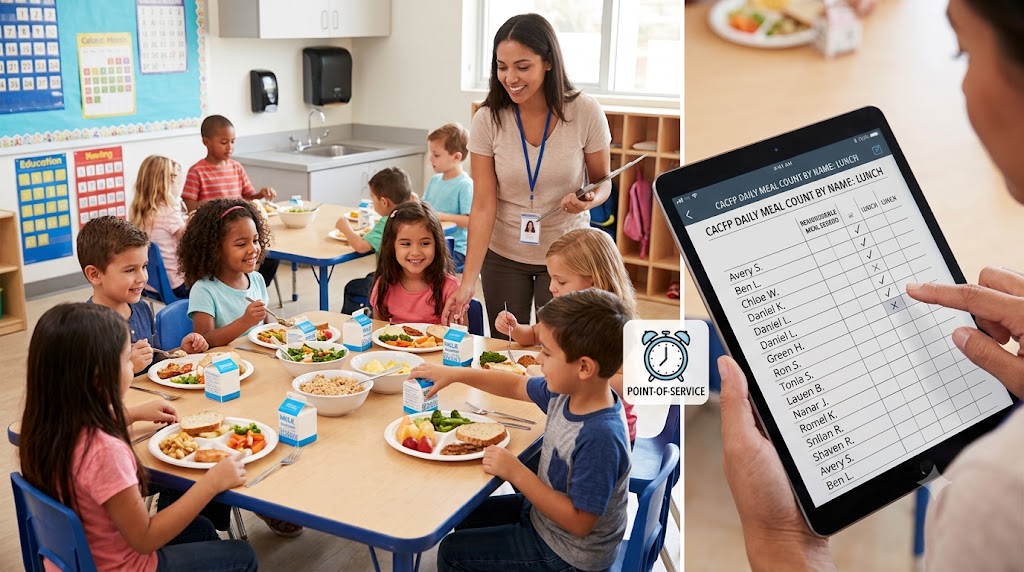
A CACFP point-of-service meal count is a record, taken while each meal or snack is being served, of every enrolled participant who received a reimbursable meal. Federal rules require centers to keep daily attendance records and time-of-service meal counts by meal type (7 CFR 226.15(e)(4)). Counts reconstructed from attendance or memory may not support reimbursement.
Key takeaways
- Count each child by name at the moment the reimbursable meal is served — not before, and not from the attendance sheet afterward.
- Use your state agency’s or sponsor’s required record format. A by-name record with the date, meal type, and recorder identification provides a useful trail for claim review.
- Attendance supports the meal count; it never replaces it.
- In family-style service, count the child when all required components are on the table in sufficient amounts and the child is participating.
- Compare counts to attendance the same day so errors are fixed before the claim.
Updated October 7, 2026 · For child care centers. Federal recordkeeping baseline: 7 CFR 226.15(e)(4); family-style guidance: USDA CACFP 02-2025. Follow your state agency’s or sponsor’s required forms and procedures.
Introduction
CACFP point-of-service meal counts are one of the most important daily records in a child care food program—and one of the easiest places for small mistakes to create claim problems. When classrooms are busy, children are transitioning, and meals are served family-style, it can be hard to know exactly when and how to document meals correctly.
This guide walks through a practical, step-by-step process for recording meal counts by name, at the point of service, for each meal and snack served. You’ll also see examples for family-style dining, common errors to avoid, and how accurate documentation connects directly to clean CACFP claims.
What Are CACFP Point-of-Service Meal Counts?
CACFP point-of-service meal counts are records taken when a reimbursable meal or snack is actually served to an enrolled participant. In plain language: you count the child at the meal, not from memory later and not from the attendance sheet alone.
A point-of-service meal count should show:
- Who was served
- Which meal or snack they were served
- When the meal count was recorded
- Whether the meal or snack was reimbursable under CACFP requirements
This is different from attendance. A child may be present at your center but not eat breakfast. Another child may arrive after breakfast but be present for lunch and snack. Attendance helps support your records, but it does not replace meal counts.
USDA’s CACFP nutrition standards explain that participating centers and day care homes serve meals and snacks that meet specific meal pattern requirements. Those requirements matter because only meals and snacks that meet CACFP rules and are properly documented can be included in claims. (fns.usda.gov)
Why “By Name” Matters
CACFP Solutions recommendation: This guide uses a by-name classroom workflow to connect each meal to the participant served. The cited federal provision requires time-of-service counts by meal type for centers; additional format requirements come from your state agency or sponsor. Use their required method. Recording staff initials or a login is a useful accountability practice unless your required form specifies otherwise.
A daily total—such as “23 lunches served”—may tell you how many meals were recorded, but it does not show which children received those meals. A by-name meal count provides a clear trail from enrollment and attendance to the meal service record and, eventually, to the claim.
By-name counts help answer important review questions, such as:
- Was the child enrolled and eligible to participate?
- Was the child present during that meal service?
- Was the child actually served a reimbursable meal or snack?
- Was the same child claimed for only the meals allowed under CACFP rules?
This level of detail protects your program. It also makes claim review, internal monitoring, and audit preparation much less stressful.
How to Record CACFP Point-of-Service Meal Counts by Name
A strong meal count system should be simple enough for staff to use during a busy day and detailed enough to support your monthly claim. The goal is not to create more paperwork—it is to create a reliable habit that keeps your food program accurate.
Step 1: Start With a Current Classroom Roster
Before meal service begins, each classroom or group should have a current roster of enrolled participants. The roster should match your program records and be updated when children enroll, withdraw, change classrooms, or change schedules.
For each child, your meal count form or digital system should clearly show the child’s name. Some programs also include age group, classroom, or enrollment status, depending on the structure of the center.
Avoid using a generic tally sheet as your only record. A tally may be useful for kitchen planning, but it does not provide the same support as a by-name record.
Step 2: Confirm the Meal or Snack Being Served
Each meal count should be tied to a specific meal type, such as:
- Breakfast
- Lunch
- Supper
- Morning snack
- Afternoon snack
- Evening snack, if applicable
This matters because CACFP claims are organized by meal type. A child served lunch should not accidentally be marked under snack, and a snack count should not be added to a lunch total.
Staff should also know what menu is being served and whether the planned meal meets CACFP meal pattern requirements. If the meal changes, the menu record should be updated as well.
Step 3: Serve the Reimbursable Meal or Snack
A meal should be counted only when the child is served a reimbursable meal or snack. That means the required components must be offered or served according to the applicable CACFP meal pattern and your approved meal service method.
For example, at lunch, staff need to know which components are required and what minimum serving expectations apply for the child’s age group. USDA provides CACFP meal pattern resources for breakfast, lunch, supper, and snacks, and these standards should guide your menu planning and staff training. (fns.usda.gov)
This is where training matters. A teacher who understands the basics of reimbursable meals is much more likely to record counts accurately. They do not need to become compliance experts overnight, but they should know enough to recognize when a meal should—or should not—be counted.
Step 4: Mark the Child’s Name at the Point of Service
Once the child has been served the reimbursable meal or snack, mark that child’s name on the meal count record for that specific meal.
This should happen during the meal service, not during nap time, at the end of the day, or when preparing the monthly claim. Waiting until later increases the chance of errors, especially when children arrive late, leave early, refuse a meal, switch classrooms, or are absent for part of the day.
A simple classroom workflow might look like this:
- Staff confirm the correct meal count sheet or digital screen is open.
- Children are served the required meal or snack.
- Staff mark each child by name as they are served.
- Staff review the sheet before the meal period ends.
- The completed count is submitted or saved according to your center’s process.
The exact format can vary. Some providers use paper forms, while others use digital tools. What matters most is that the record is accurate, timely, legible, and connected to the correct child and meal.
Step 5: Compare Meal Counts to Attendance
After meal service, meal counts should be checked against attendance. This does not mean attendance replaces the meal count. It means attendance can help you spot possible mistakes.
For example:
- A child marked absent should not usually have a meal count.
- A child who arrived after breakfast should not be counted for breakfast.
- A child who left before afternoon snack should not be counted for that snack.
- A child present all day may still not be counted for a meal if they were not served.
This review can be done by the classroom lead, office staff, food program manager, or another trained person. The best time to catch errors is the same day, while staff still remember what happened.
Step 6: Submit Counts for Claim Preparation
Meal counts eventually become part of your CACFP claim. If the daily records are unclear, incomplete, or inconsistent, the claim may be delayed, reduced, or questioned during review.
Strong records make claim preparation much easier. The monthly claim should be based on actual point-of-service meal counts, supported by attendance, enrollment records, menus, and other required documentation.
Family-Style Dining and Point-of-Service Meal Counts
Family-style dining is a popular approach in child care because it allows children to practice independence, social skills, and healthy eating behaviors. But it can also create confusion about when to count a meal.
USDA describes family-style meal service as a method where food is placed on the table in serving dishes and children serve themselves, with help from adults as needed. USDA guidance also recognizes family-style meals as a way to support children’s development while meeting CACFP meal pattern requirements when implemented correctly. (fns.usda.gov)
When Do You Count the Meal in Family-Style Service?
In family-style dining, staff should count the child when the reimbursable meal has been made available to the child according to CACFP family-style meal service expectations. The exact process may depend on state agency or sponsor guidance, so providers should follow their approved procedures.
A practical approach is to document the meal count once:
- The child is seated and participating in the meal service;
- The required food components are available in sufficient amounts;
- The child has the opportunity to serve themselves, with adult help if needed; and
- Staff can confirm the child was present for that meal or snack.
Supervising adults must encourage children to take the full required serving of each component. A child who declines a component or takes less after encouragement may still have a reimbursable family-style meal when the required portions were made available. This is different from waiting to see whether a child eats every component. In family-style service, children may choose how much of each food they take, and adults may encourage participation without forcing children to eat.
Because states and sponsors may give specific instructions on family-style documentation, confirm your local procedure before changing your process. USDA’s family-style meal service resources are a helpful starting point, but your state agency or sponsoring organization should be your final source for program-specific expectations. (fns.usda.gov)
Family-Style Example: Lunch in a Preschool Classroom
Imagine a preschool classroom serving lunch family-style. The menu includes all required lunch components for the age group. Serving bowls and utensils are placed on the table, and staff sit with children to supervise and assist.
A child named Maya is present, seated, and offered all required meal components. She serves herself fruit and milk but initially says no to the vegetable. The teacher encourages her gently and keeps the vegetable available.
Maya may still be counted if the meal was served according to the approved family-style method and all required components were properly offered. The teacher should mark Maya’s name for lunch at the point of service, not later in the afternoon.
Now consider another child, Jordan, who arrives after lunch service has ended. Even if there are leftovers available, Jordan should not automatically be added to the lunch count unless he is actually served a reimbursable lunch during an approved meal service time and your procedures allow it. This is the kind of situation where written procedures help staff make consistent decisions.
Family-Style Example: Snack With Mixed Participation
For snack, the classroom serves two required components. Several children sit at the table and are offered the snack family-style. One child is present but asleep in the rest area and does not come to the table or receive the snack.
The children who are present and served according to the snack procedure may be counted by name. The sleeping child should not be counted simply because they were in attendance that day.
This distinction is important. Attendance tells you the child was at the facility. The point-of-service count tells you the child was served the snack.
Common Meal Count Errors That Cause Claim Problems
Most CACFP meal count errors are not intentional. They happen because staff are busy, forms are confusing, training is inconsistent, or the center does not have a clear workflow. The good news is that these problems can usually be corrected with better systems.
Using Attendance as the Meal Count
This is one of the most common errors. Attendance records show who was present, but they do not prove which meals or snacks each child received.
A child may be present for only part of the day. Another child may be present but not served a particular snack due to a schedule change, appointment, late arrival, or early pickup. If you claim based only on attendance, your meal totals may be inaccurate.
Attendance should support the meal count—not replace it.
Recording Counts After the Fact
When staff fill in meal counts at the end of the day, they are relying on memory. That creates risk, especially in larger classrooms or programs with multiple meal services.
After-the-fact recording can lead to:
- Counting children who were absent
- Missing children who were served
- Marking the wrong meal type
- Forgetting late arrivals or early departures
- Duplicating counts during classroom transitions
Point-of-service documentation prevents many of these issues because staff record what is happening while it is happening.
Counting Meals That Do Not Meet CACFP Requirements
A meal count is only claimable if the meal or snack is reimbursable. If a required component is missing, the menu does not meet the meal pattern, or the food served is not creditable, the meal may not be eligible for reimbursement.
This is why meal count training should be connected to menu training. Staff do not need to memorize every rule, but they should know when to ask for help.
Not Updating Rosters
Outdated rosters create confusion. A withdrawn child may remain on the meal count sheet. A new child may be written in by hand without complete enrollment documentation. A child who moved classrooms may be counted in the wrong room.
Rosters should be updated promptly and reviewed regularly. If your program uses digital meal count tools, make sure staff know how updates are made and who is responsible for maintaining accurate child information.
Missing Staff Initials, Dates, or Meal Types
A meal count record should clearly show what it represents. If a reviewer cannot tell which date, classroom, meal, or staff person the record belongs to, the documentation may be questioned.
Paper forms should be legible and complete. Digital records should be saved correctly and reviewed for accuracy. A quick daily check can prevent small omissions from becoming claim issues later.
Claiming More Meals Than Allowed
CACFP rules limit the number and types of meals and snacks that may be claimed per participant per day, depending on the setting and program approval. Because these rules can vary by provider type and program structure, confirm your approved claiming limits with your sponsor or state agency.
The key takeaway is simple: your claim should reflect only allowable meals and snacks that were actually served and properly documented.
A Practical Daily Workflow for Accurate CACFP Claims
Accurate claims begin long before the monthly claim is submitted. They start in the classroom, at the table, with staff who understand what to record and when to record it.
Here is a practical workflow many child care providers can adapt.
Before Meal Service
Start by confirming that the classroom has the correct roster, the correct date, and the correct meal type. Staff should know what is on the menu and whether there are any substitutions, special dietary needs, or schedule changes.
If a substitution is made, it should be documented according to your procedures. If a child requires a meal modification, staff should know where to find the approved documentation and how that affects service.
This is also a good time to make sure the person responsible for meal counts is clearly identified. When “everyone” is responsible, it is easy for no one to take ownership.
During Meal Service
As children are served, staff mark the meal count by name. For family-style meals, staff follow the approved procedure for counting children when the reimbursable meal is made available and the child participates in the meal service.
The meal count form or digital device should be accessible but protected. Staff should not have to leave the table for several minutes to find the form, and they should not rely on memory until after cleanup.
If a child arrives late, staff should follow the center’s written process. If the child is served a reimbursable meal within an approved meal service period, the child may be recorded. If not, the child should not be added just because they are present later.
After Meal Service
Before moving on to the next activity, staff should quickly review the meal count. Are all served children marked? Are absent children unmarked? Is the date correct? Is the meal type correct?
Then, the meal count should be submitted according to your program’s process. This might mean turning in a paper form to the office, saving a digital record, or syncing the meal count in your software.
A second-level review can be helpful, especially for centers with multiple classrooms. Office staff or the food program manager can compare meal counts with attendance, enrollment, and menu records before the claim is prepared.
During Claim Preparation
When it is time to prepare the claim, your team should not be guessing. The claim should be built from daily point-of-service records that are already complete and reviewed.
Before submission, check for unusual patterns:
- A child counted for a meal on a day they were absent
- A classroom with identical counts for every meal every day
- Meal counts that exceed attendance
- Missing meal count sheets
- Meals claimed without a matching menu
- Counts that do not align with enrollment dates
These patterns do not always mean something is wrong, but they should be reviewed before the claim is submitted. Catching issues early protects reimbursement and reduces stress during monitoring or state review.
If daily records are difficult to organize or reconcile for the monthly claim, explore claims-processing and ongoing support to see what the service includes.
Training Staff to Get Meal Counts Right
Even the best form will not fix a process that staff do not understand. Meal count accuracy depends on clear expectations, hands-on training, and regular follow-up.
Training should explain not only what to do, but why it matters. When staff understand that meal counts affect reimbursement, compliance, and the center’s ability to keep serving nutritious meals, the task feels less like paperwork and more like part of caring for children.
What Staff Should Know
Every staff member involved in meal service should understand:
- The difference between attendance and meal counts
- When to mark a child as served
- How to handle late arrivals and early pickups
- What to do when a child refuses food
- How family-style meal counts work
- Who to ask when something unusual happens
- Why meal counts must be completed at the point of service
Keep training practical. Use real classroom examples. Walk through your actual forms or digital system. Ask staff what situations confuse them, then build those scenarios into your procedures.
Create Written Procedures
A short written procedure can prevent many errors. It does not need to be complicated. In fact, the best procedures are usually simple enough for a new staff member to follow during a busy meal.
Your written procedure should answer questions like:
- Where are meal count records kept?
- Who records the meal count?
- When exactly is the count taken?
- What happens if a child arrives late?
- What happens if a child is present but not served?
- Who reviews the records?
- How are corrections documented?
Corrections should never look like guesswork. If a mistake is found, follow your sponsor or state agency’s correction procedures. Avoid white-out, unexplained changes, or rewriting records after the fact.
Review Regularly, Not Just Before a State Visit
Meal count systems work best when they are checked routinely. A five-minute review each day can prevent hours of cleanup later.
Program leaders can periodically observe meal service, compare records to attendance, and ask staff to explain the process. This should feel supportive, not punitive. The goal is to catch confusion early and help staff feel confident.
Remember, CACFP requirements, forms, reimbursement rates, and deadlines may change. Always confirm current figures and procedures with your sponsoring organization or state agency, especially at the start of a new program year.
Conclusion
Accurate CACFP point-of-service meal counts are the foundation of reliable claims. When your team records each child by name, at the meal or snack, and connects those records to attendance, menus, and enrollment, your program is much better prepared for monthly claims and reviews.
You do not have to build the perfect system overnight. Start with a clear workflow, train your staff, review records consistently, and ask for support when something feels unclear.
Need Help Connecting Meal Counts to Your Monthly Claim?
If your team is struggling to organize daily records or prepare the monthly claim, explore our claims-processing and ongoing support services. You can see what the service includes and discuss whether it fits your program.
Explore claims-processing support
Frequently asked questions
When must CACFP meal counts be taken?
At the point of service — while the meal or snack is being served to each child. Counts recorded before service, at nap time, or at the end of the day are not point-of-service counts and put the claim at risk.
Can attendance be used as the meal count?
No. Attendance shows who was at the center; the meal count shows who was served a reimbursable meal. A child can be present and not served, or arrive after a meal. Attendance is used to cross-check the count, not to create it.
How do meal counts work for family-style meals?
Count the child once the full reimbursable meal has been made available at the table in sufficient quantities and the child is seated and participating, following your state agency’s or sponsor’s written procedure. Children choose their own portions, so the count does not depend on how much each child eats.
What must a CACFP meal count form include?
Use the form or electronic record required by your state agency or sponsor. Federal rules require daily attendance records and time-of-service meal counts by type for centers. A by-name record with the date, meal type, and recorder identification is the practical workflow recommended in this guide.
Sources
- 7 CFR 226.15(e)(4) — Attendance and time-of-service meal counts for centers
- USDA FNS Team Nutrition — Family Style Meals in the CACFP
- TDA CACFP Policy and Handbook — Texas guidance; see Section 4300, Counting, Claiming, and Reimbursement
- USDA CACFP 02-2025: Offer Versus Serve and Family Style Meals — USDA memo hosted by the Arizona Department of Education